Blog

Under the Hood #2: Improved VIEWS Management

Posted by Eugenio on 23 Oct 2026

Dear users,
if you have built a complex DaDaBIK application, you probably already know how powerful Database VIEWS can be.

You can use a VIEW to create filtered subsets of your data, add calculated fields, join multiple tables, simplify complex queries or expose a cleaner structure without changing the underlying database.

In this second episode of DaDaBIK Under the Hood, I show the new and improved VIEWS management features currently under development.

You can now modify an existing VIEW with one click directly from DaDaBIK's Data section, while DaDaBIK takes care of synchronizing its internal configuration with the updated fields.

It is also now possible to copy Form Configurator settings from a table to a VIEW even when the two have a different set of fields, making it much easier to reuse an existing configuration.


Watch the video


Since these features are still a work in progress, there is still room to change direction. Feedback, suggestions and alternative ideas are very welcome and may actually influence the final implementation.

Best,

--
Eugenio Tacchini
Founder, DaDaBIK
DaDaBIK + Jev AI: turn free text into actionable data

Posted by Eugenio on 1 Oct 2026

Dear users,
You may have heard about Jev, TypeSafe AI's new model, released just two weeks ago and designed for fast, structured decisions inside software.

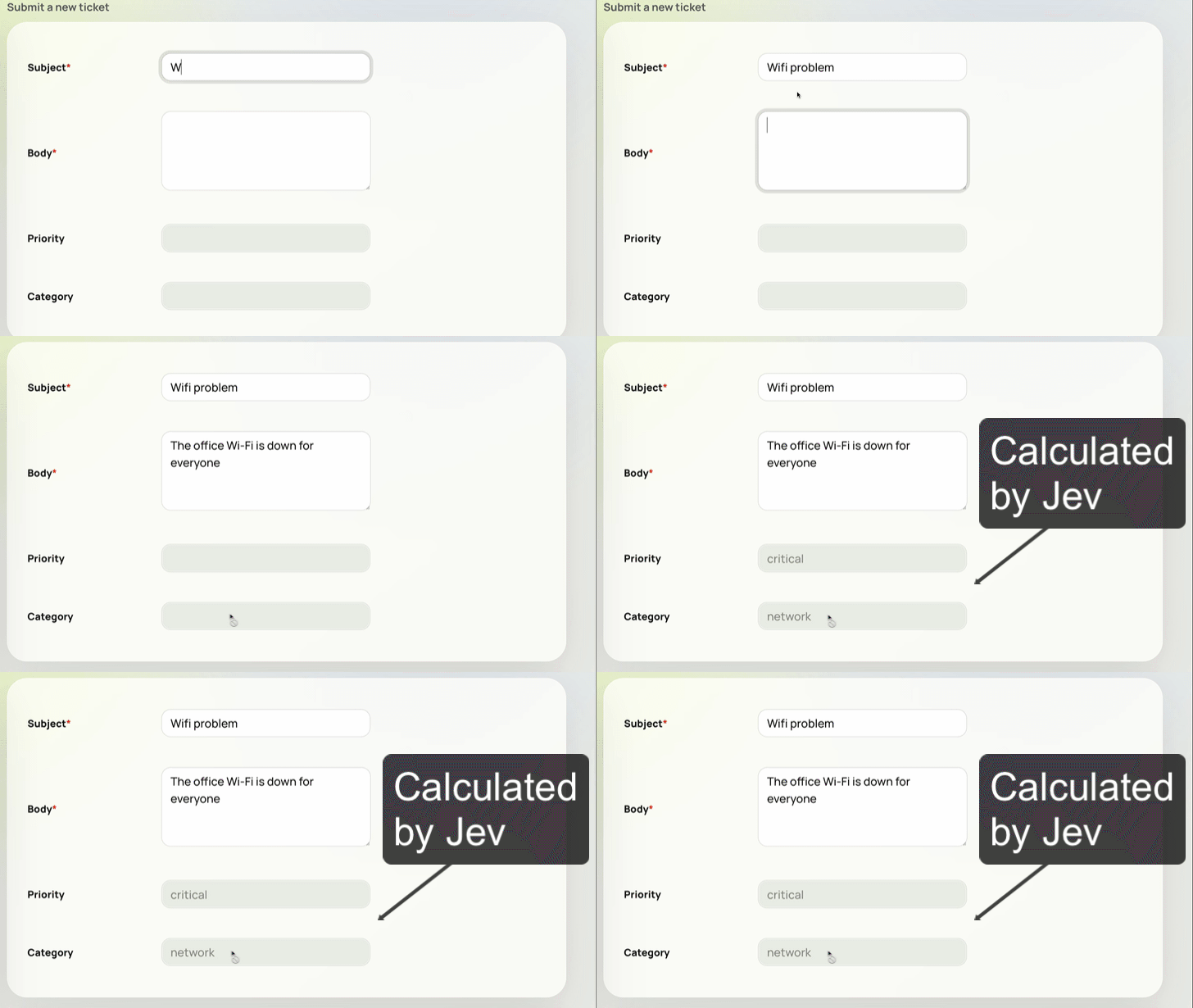
I built a small IT ticketing application in DaDaBIK to see how naturally Jev could fit into a real application.

A user simply writes something like:

“The office Wi-Fi is down for everyone.”

DaDaBIK sends the ticket to Jev, which automatically determines its category, priority and confidence. Those results are then stored as normal database fields and can immediately be used for filters, dashboards, assignments, notifications and workflows.

Jev classification screenshot

You can think of these as a new kind of AI-calculated field: instead of calculating a value with a formula, the field is derived from the meaning and context of the data entered by the user.

And ticket classification is just one example. The same pattern can be used for CRM lead qualification, customer feedback analysis, document classification, expense approval workflows and many other DaDaBIK applications.

I show the complete integration, including the DaDaBIK after-insert hook and the Jev API call, in a new YouTube video: Watch the video.

What I particularly like about this approach is that AI becomes part of the normal application workflow rather than something separate from it. Jev produces structured information, DaDaBIK stores it in ordinary fields, and from that point on the rest of the application works exactly as usual.

I think AI-calculated fields could become a very interesting pattern for DaDaBIK applications and I'm already thinking about how this kind of integration could be made even more native in the future. Let me know what you think!

Best,

--
Eugenio Tacchini
Founder, DaDaBIK
DaDaBIK Notifications Center (Under the Hood #1)

Posted by Eugenio on 17 Sep 2026

Dear users,
Today I'm starting a new YouTube series, DaDaBIK Under the Hood.

The idea is to introduce new features while they are still under development and before they become officially available in DaDaBIK.

Not only will I show the feature in action: I'll talk about where the idea came from, the problem I'm trying to solve, the design and implementation choices.

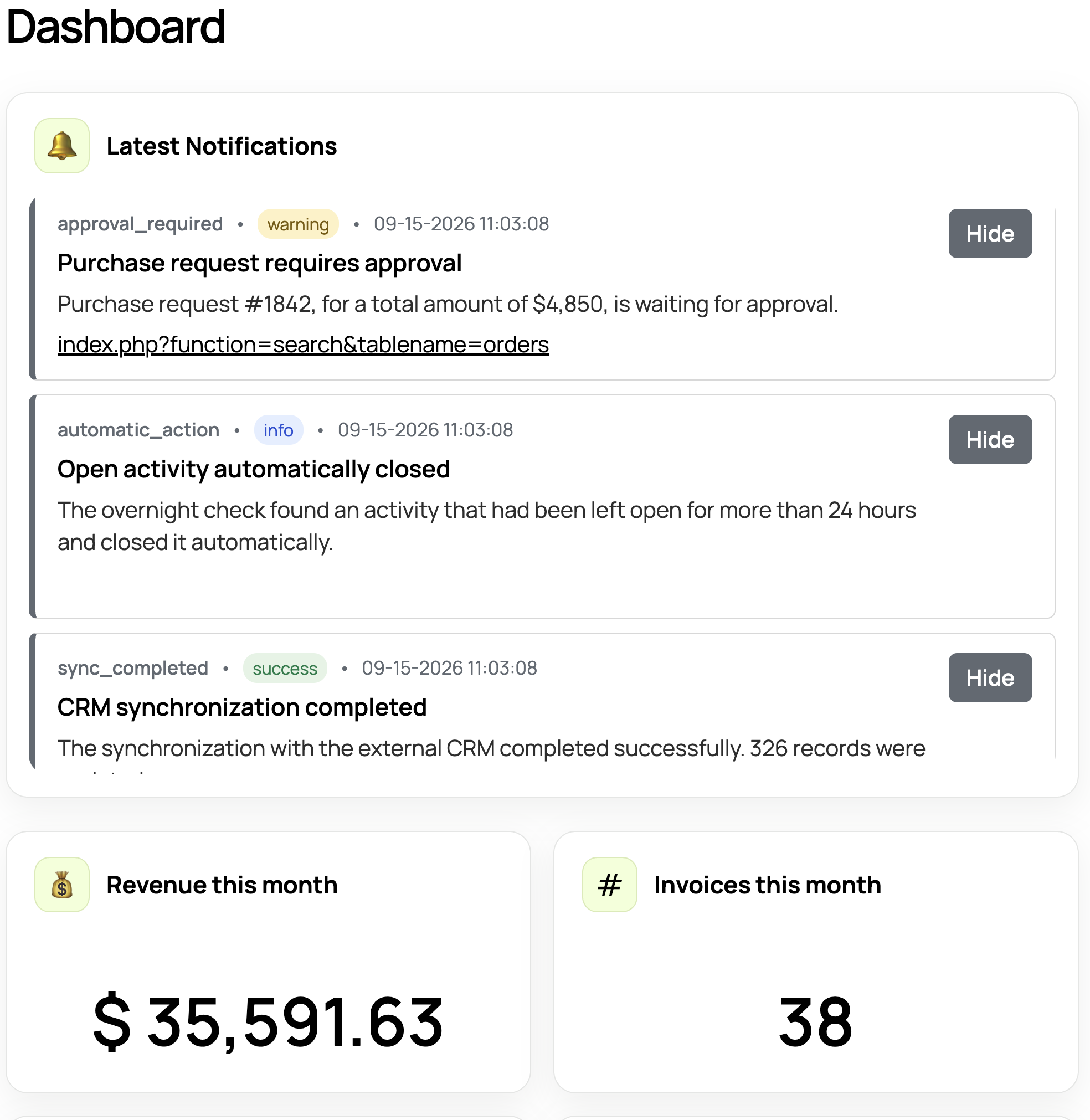
We'll start with the Notifications Center. Sometimes you need to notify the users of your applications when something happens (an order needs approval, a deadline is approaching, a user self-registers, ... ).

We now have a Notification Center where users can see all their notifications, a simple method to embed the latest notifications pm your homepage and a create_notification() method to generate notifications from your own custom code.

Notifications embedded in homepage


Watch the video


Since these features are still a work in progress, there is still room to change direction: feedback, suggestions and alternative ideas are very welcome and may actually influence the final implementation.

This is a pilot episode of this series, the idea is to continue with other episodes but I don't know yet how many episodes there will be or how often I'll publish them, let's see how it goes and what kind of feedback I get :)

Best,

--
Eugenio Tacchini
Founder, DaDaBIK

v13.6 is out – PHP 8.5 support, Dada Inventory & more

Posted by Eugenio on 27 Aug 2026

Dear users,
DaDaBIK v13.6 is now available and officially supports PHP 8.5.
In previous versions, including v13.5, running DaDaBIK on PHP 8.5 could result in errors, particularly deprecation warnings.

With v13.6 I've also decided, after discussing this with the community, to drop support for PHP 7; so the minimum PHP version required to run DaDaBIK is now PHP 8.1.

Get DaDaBIK 13.6 here

Here are some of the other highlights


  • v13.6 fixes some of the bugs that affected the new modern UI (which, remember, can be enabled by setting $ui_style = 'modern'), there is an ongoing discussion about the new UI here in this forum thread.

  • this YouTube video.


  • change log.

    You can buy a new license here.

    You can upgrade your existing license (free if within your free upgrade period or with an active subscription) from the upgrade page.

    Feel free to reply to this email if you have any questions.

    Best,

    --
    Eugenio Tacchini
    Founder, DaDaBIK

Should we drop PHP 7 support?

Posted by Eugenio on 14 Aug 2026

Dear users,
the next release of DaDaBIK (v13.6) will officially support PHP 8.5 and I am wondering whether we should finally drop PHP 7 support.

Yes, apart from a few features that require PHP 8.3 (Barcode / QR Code generation, Google OAuth2 authentication and iCal export), DaDaBIK still supports PHP 7.

I personally haven't used PHP 7 for many years, but according to our installation statistics, more than 10% of the DaDaBIK installations made in 2026 are still running PHP 7. This is higher than I expected, and I am curious to understand what is keeping those installations on PHP 7: hosting limitations, legacy applications running on the same server, compatibility requirements, or something else.

Dropping PHP 7 support would allow us to use PHP 8-only syntax and features, simplify some parts of the codebase and, importantly, reduce the size of the DaDaBIK ZIP package by about one third.

On the other hand, I don't want to drop PHP 7 support if a significant number of users still have good reasons for relying on it (although, at least from a security standpoint, they should absolutely be planning to upgrade to a supported PHP version).

Let me know what you think. I am particularly interested in hearing from users who are still using PHP 7 and understanding why they haven't moved to PHP 8 yet.

You can reply to this email or, even better, add your thoughts to this forum post.

Best,

--
Eugenio Tacchini
Founder, DaDaBIK

Page 1 of 32
1  2  3  4  5  6  7  8  9  10  >  >>  

Top